
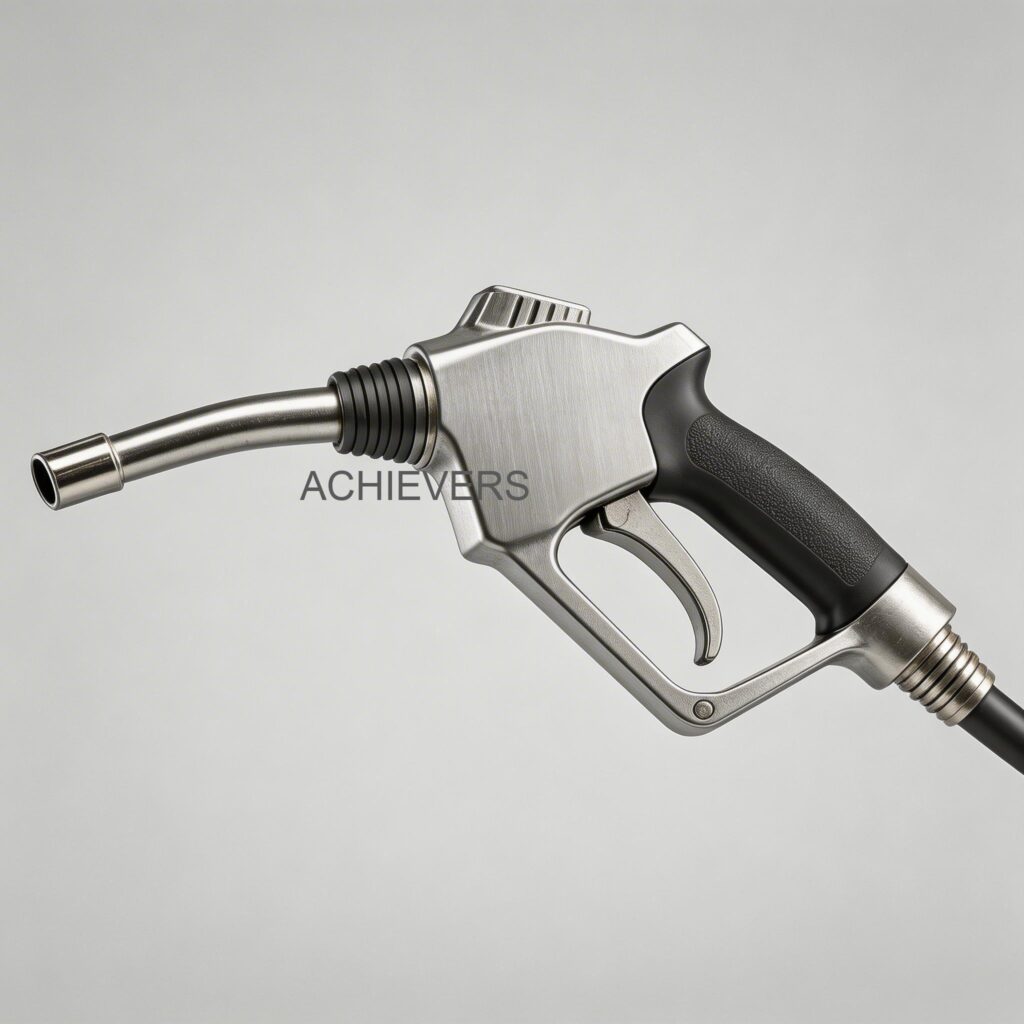
Many Indian industrial buyers view fuel dispensing accessories as consumable expenses rather than strategic investments. When outfitting a factory skid tank in a Gujarat Industrial Development Corporation (GIDC) estate or managing a transport fleet yard, procurement heads often default to the cheapest available manual spouts. However, with commercial diesel prices hovering near ₹90 to ₹100 per litre depending on the state, even a 0.5% loss from minor overfills, slow dispensing times, or accidental spillage translates to significant financial leakage over a financial year.
A high-quality Fuel Nozzle is not just a delivery spout; it is the frontline measurement and control mechanism in your fluid transfer system. By preventing drive-offs, eliminating overflow, and enduring the harsh, dusty, and high-heat conditions of Indian industrial sites, upgrading your dispensing equipment offers one of the fastest returns on investment (ROI) in plant operations. This detailed guide provides a practical framework to calculate the total cost of ownership (TCO) and payback period for automated dispensing nozzles in the Indian market.
1. Product Overview and Cost Context
In heavy-duty Indian applications—such as mining, construction, food processing, and logistics—equipment takes a beating. The Fuel Nozzle manufactured by Lumen Instruments is engineered specifically for these demanding environments. Operating safely at a maximum design working pressure of 50 psi (3.45 bar), this nozzle is compatible with gasoline, diesel, and up to 10% ethanol blends, making it highly versatile for modern fleets.
Unlike standard aluminium nozzles that wear out quickly from constant friction with vehicle fuel necks, this unit features a stainless steel spout tip proven to last four times longer. Furthermore, it undergoes rigorous internal OPW lab testing, proving a lifespan of over 1 million cycles. The inclusion of the "Flowloc" feature is highly critical for safety and loss prevention; if the nozzle falls out of a vehicle or is tipped upwards, it automatically shuts off, limiting dangerous spillage. Combined with "accu-stop" to-the-penny flow control technology and an attractive 2-piece newgard™ hand insulator, the operator experiences maximum comfort and precise filling.
In Simple Terms:
When an operator locks the handle to fill a truck, they might walk away to check tyres. If the tank fills up, an automatic nozzle senses the fuel level and instantly snaps shut. A manual nozzle would keep pumping, spilling ₹90/litre diesel onto the ground until the operator notices. The automatic shut-off feature pays for itself the very first time it prevents an overflow.

2. Total Cost of Ownership Breakdown
When evaluating a Fuel Nozzle, comparing only the initial purchase price is a mistake. A standard manual nozzle might cost ₹1,500, while a heavy-duty automatic shut-off model ranges from ₹3,500 to ₹8,500 (plus 18% GST). However, the manual nozzle often fails within months and causes thousands of rupees in fuel loss. To make a confident, budget-conscious buying decision, plant managers must look at the 3-year Total Cost of Ownership.
Here is a typical TCO breakdown for a high-usage Indian industrial site (dispensing ~2,000 litres of diesel daily):
| Cost Component | Typical Range (INR) | Frequency | Notes |
| — | — | — | — |
| Upfront Purchase Price | ₹3,500 – ₹8,500 | Once (Years 1-3) | Excludes GST. Price varies if integrating a flow meter. |
| GST (18%) | ₹630 – ₹1,530 | Once | Input Tax Credit (ITC) can be claimed by GST-registered businesses. |
| Installation Labour & Swivels | ₹500 – ₹1,200 | Once | Minor piping adaptations, BSP thread matching, and swivel joint fitting. |
| Operator Time (Fill Speed) | Savings of ₹15,000+ | Annual | Hold-open clip frees operator to do other tasks, increasing site efficiency. |
| Spillage & Overflow Losses | ₹0 (Prevented) | Annual | Manual nozzles easily waste 15-20 litres a month (approx. ₹18,000/year). |
| Routine Maintenance/Spares | ₹500 – ₹1,000 | Annual | Cleaning strainers, replacing hold-open clip spring if subjected to abuse. |
| Replacement Lifespan Cost | ₹0 for 1M cycles | Over 3 Years | Stainless steel tip lasts 4x longer than aluminium; zero replacement needed. |
| Total 3-Year Lifecycle Cost | ₹6,130 – ₹13,230 | Cumulative | Yields net positive ROI within the first 6 months due to saved fuel. |

3. ROI Calculation: Real-World Indian Example
To justify the upgrade from manual dispensing to an automatic shutoff nozzle, you need to quantify the exact payback period. Assume an Ahmedabad-based logistics company operates a captive Diesel Dispensing station for its fleet of 20 trucks. They dispense 1,500 litres per day.
Follow this numbered procedure to calculate the real-world ROI:
- Establish the Spillage Baseline: Audit the dispensing island. Observe that manual topping-off and minor overflows cause an average loss of 0.5 litres per day.
- Calculate Monthly Fuel Loss: 0.5 litres/day × 30 days = 15 litres lost per month.
- Quantify Financial Leakage: At an average local pricing of ₹92 per litre of diesel, the monthly loss is 15 × 92 = ₹1,380 per month.
- Factor in the Upgrade Cost: The business purchases a heavy-duty automatic nozzle with a stainless steel spout for ₹4,500 (GST inclusive cost: ₹5,310).
- Calculate Labour Savings: Using the hold-open clip, the operator saves 2 minutes per truck. For 20 trucks, that is 40 minutes saved daily, translating to approximately ₹1,200 in reclaimed labour hours per month.
- Determine Total Monthly Savings: Fuel savings (₹1,380) + Labour productivity (₹1,200) = ₹2,580 per month.
- Subtract Ongoing Maintenance: Estimate a conservative ₹100 per month for periodic cleaning of the internal strainer to handle contaminated Indian diesel. Net savings = ₹2,480 per month.
- Calculate Simple Payback Period: Divide the total initial cost (₹5,310) by the net monthly savings (₹2,480). The payback period is exactly 2.14 months. After 65 days, the equipment generates pure financial return.
4. Cost Comparison: Available Approaches
Depending on your specific industry sector—be it a standby power generation plant or a busy commercial weighbridge—different dispensing solutions make sense.
| Approach | Upfront Cost (INR, Ex-GST) | Annual Spillage Cost | Accuracy & Control | Reliability | Best For |
| — | — | — | — | — | — |
| Basic Manual Spout | ₹800 – ₹1,500 | ₹10,000 – ₹20,000 | Poor (relies on eyesight) | Low (Aluminium wears fast) | Small farms, infrequent emergency use. |
| Automatic Shutoff Nozzle | ₹3,500 – ₹6,000 | ₹0 (Auto-stop) | High (Accu-stop flow) | Excellent (1M+ cycles) | Fleet yards, GIDC factory skids, transport. |
| Auto Nozzle with Flow Meter | ₹8,000 – ₹15,000 | ₹0 | Superior (Digital tracking) | High | Mining, construction sites needing batch tracking. |
| High-Flow Industrial Dispenser | ₹45,000+ | ₹0 | PESO Approved limits | Industrial Grade | Large petroleum depots, commercial retail outlets. |
Note: For applications requiring strict internal audits, pairing an automatic nozzle with a dedicated Diesel Flow Meter ensures that every drop dispensed matches your inventory records.
5. Hidden Costs to Budget For
Indian industrial environments present unique challenges that can degrade equipment prematurely if not accounted for. Budgeting for a nozzle upgrade should include awareness of the following hidden costs:
- Power Quality and Pump Strain: An automatic nozzle shutting off abruptly causes a sudden pressure spike (water hammer effect) in the hose. If your existing Fuel Transfer Pumps do not have an internal bypass valve, this pressure can burn out the pump motor. Always ensure pump compatibility.
- Fuel Contamination: Indian diesel often contains particulate matter or water due to condensation in monsoon months. You must budget for external line strainers (₹1,000 – ₹2,500) to prevent debris from jamming the automatic shutoff sensor inside the spout tip.
- Swivel Joints and Hose Threads: Standard Indian piping relies heavily on BSP threads, whereas some imported equipment uses NPT. You may need to budget ₹500 – ₹1,000 for brass adaptors and a heavy-duty multi-plane swivel to prevent the hose from twisting and breaking the nozzle inlet.
- Calibration for Metered Models: If you purchase a nozzle with an integrated digital meter, the Legal Metrology Act requires periodic calibration for custody transfer, or at least annual internal calibration for accuracy. Budget ₹1,500 – ₹3,000 annually for testing via a calibrated proving can.
- Operator Training Time: Operators accustomed to manual spouts often try to jam the lever guard open using a piece of wood or a stone. While the durable duratuff lever guard resists scratching, training operators on the built-in hold-open clip spring is necessary to prevent physical breakage.
- GST and Tax Implications: Always ensure purchases are made with proper HSN codes so your finance department can claim the 18% Input Tax Credit. Buying unorganized, non-billed "cheap" equipment actually costs 18% more because ITC cannot be claimed.

6. How to Justify the Purchase to Management
Getting approval for a ₹5,000 to ₹15,000 equipment purchase is straightforward if you frame it around risk reduction and ROI rather than just "needing a new spare part." Use this proven procedure to build your business case for plant management:
- Document Current Losses: Take photos of the diesel stains on the concrete around your current dispensing island. Quantify this environmental hazard and fuel loss.
- Highlight the Cycle Testing: Emphasize that the proposed upgrade is cycle-tested to last longer than 1 million cycles. Explain that the stainless steel spout tip lasts 4 times longer than standard aluminium, eliminating quarterly replacement budgets.
- Present the Safety Angle: Explain the "Flowloc" feature. Management is always sensitive to safety. If an operator trips and the nozzle falls out of the vehicle, it shuts off automatically, preventing a massive spill and potential fire hazard.
- Show the Math: Present the 8-step ROI calculation from Section 3. Show them that the payback period is less than 3 months.
- Emphasize the 'Make in India' Supply Chain: Mention that buying from an Ahmedabad-based manufacturer ensures immediate availability of spare parts, unlike imported units that face customs delays and high import duties.
- Propose a Pilot Run: If management is still hesitant, suggest buying just one automatic nozzle for your highest-volume diesel dispenser. Track the filling speed, reduced spillage, and operator feedback for 30 days before rolling it out to the rest of the plant.
FAQ
Q: What is the typical GST-inclusive cost for a commercial automatic fuel nozzle in India?
A: A high-quality automatic nozzle generally ranges from ₹3,500 to ₹8,500 depending on flow rate capacity and materials. With an 18% GST applied, expect the landed cost to be between ₹4,130 and ₹10,030. Registered businesses can claim the GST back as an Input Tax Credit.
Q: How does the automatic shut-off mechanism actually work?
A: The spout contains a small vacuum tube. As fuel flows out, it draws air through this tube. When the fuel level in the vehicle's tank rises and covers the tip of the spout, it blocks the air. This change in vacuum pressure triggers a mechanical latch inside the handle, snapping the valve shut instantly to prevent overflow.
Q: Can this handle 10% ethanol-blended petrol (E10) as per Indian government mandates?
A: Yes. The internal seals and components are fully compatible with gasoline, standard high-speed diesel (HSD), and up to 10% ethanol blends (E10), ensuring compliance with current Indian fuel blending standards.
Q: What is the maintenance interval for the spout and lever guard?
A: Because the spout tip is made of stainless steel (lasting 4x longer than aluminium) and the lever guard is made from heavy-duty duratuff, physical replacements are rare. We recommend a simple monthly visual inspection and cleaning of the inlet strainer to remove dust and rust particles common in Indian storage tanks.
Q: Will it fit standard Indian fuel hoses, or do I need special adaptors?
A: Most models come with standard BSP (British Standard Pipe) female threads at the inlet, which seamlessly connect to the standard 3/4-inch or 1-inch rubber dispensing hoses used across India. A swivel joint is highly recommended for ease of use.
Q: If the unit has a hold-open clip, isn't that illegal or unsafe?
A: The hold-open clip is entirely safe when paired with an automatic shut-off sensor. It allows the operator to set the "accu-stop" flow rate. The moment the tank is full, or if the nozzle is tipped up/falls out (thanks to the Flowloc feature), the clip automatically disengages and stops the flow.
Q: Is the body prone to rusting in high-humidity monsoon conditions?
A: No. The nozzle features an attractive, flawless finish with a 2-piece newgard™ hand insulator that protects the metal body. Combined with the stainless steel tip and corrosion-resistant internal aluminium/brass components, it is built to withstand extreme monsoon humidity and high coastal salinity.
To eliminate expensive diesel spillage and speed up your fleet refuelling, upgrade to an automated dispensing solution today. Contact Lumen Instruments with your required flow rate, fluid type, and current pump specifications to get a customized, GST-inclusive quote for a heavy-duty automatic nozzle designed for rugged Indian conditions.